
You check your credit report expecting routine updates, and there it is: “Account Closed by Credit Grantor” next to a card you thought was in good standing. Your score dropped, that loan application just got denied, and you’re left wondering if this closure was even legitimate. The frustration isn’t just about the points you lost—it’s about not knowing whether this happened because of something you did, something you didn’t do, or a creditor decision that had nothing to do with your payment history at all.
Here’s what most people don’t realize: that generic remark on your report masks dozens of possible scenarios, from inactivity purges to risk-based reviews triggered by activity on completely different accounts. Some closures stem from errors you can dispute and remove. Others are legitimate but fixable through strategic rebuilding that targets your specific damage points—whether that’s a utilization crisis, lost credit history, or cascading reviews from other creditors. The difference between spinning your wheels and actually recovering comes down to understanding what really happened, verifying the accuracy across all three bureaus, and knowing which rebuild steps to take first based on your exact situation.
Understanding “Account Closed by Credit Grantor”: The Hidden Triggers Behind Involuntary Closures
When you see “account closed by credit grantor” on your credit report, you’re looking at a remark that conceals far more than it reveals. Credit card issuers close accounts for dozens of reasons, and the generic notation gives you no indication whether the closure stemmed from something you did, something you didn’t do, or a portfolio management decision that had nothing to do with your behavior at all. Understanding the specific trigger behind your closure determines whether you have grounds to dispute the action and how you should approach rebuilding.
Inactivity stands as one of the most common closure triggers, yet creditors define dormancy with wildly inconsistent thresholds. Some issuers purge accounts after just three months of no purchase activity, while others wait 12, 18, or even 24 months before initiating what they internally call “zombie account” cleanups. These portfolio purges typically happen in waves during specific quarters when creditors review their exposure to unused credit lines. The closure has nothing to do with your creditworthiness—you could have an 800 credit score and perfect payment history across all accounts—but the issuer decided that maintaining your unused $15,000 credit limit represented unnecessary risk exposure on their balance sheet. The particularly frustrating aspect of inactivity closures is that many occur on accounts where you deliberately kept the card open specifically to preserve your credit age and available credit, creating a circular problem where your strategy to protect your credit actually damages it.
Risk-based account reviews operate as continuous monitoring systems that flag accounts based on activity the creditor observes across your entire credit profile, not just your relationship with them. An issuer might close your account because you opened three new credit cards in two months, even though you never missed a payment with them and maintained low utilization on their card. They might initiate closure after detecting a 40-point credit score drop triggered by high utilization on a completely different creditor’s card, or after seeing multiple hard inquiries from auto lenders that signal you’re taking on new debt. Address changes sometimes trigger reviews, particularly moves to ZIP codes the creditor has flagged as higher risk based on their portfolio performance data. The closure happens because their algorithm determined you now represent elevated risk based on external factors, regardless of your pristine history with their specific account. What makes these closures particularly difficult to anticipate is that creditors never disclose their specific RAR triggers, and the thresholds change based on economic conditions and the issuer’s current risk appetite.
The generic “closed by grantor” remark also masks scenarios where the closure wasn’t really about closure at all, but rather the endpoint of a different creditor action. Some accounts get closed after a credit limit reduction drops your available credit below the minimum the issuer allows for that product—your $5,000 limit gets cut to $500, and since their card program doesn’t support limits that low, they close the account entirely. Relationship banking requirements create another hidden closure path, where you had a credit card tied to maintaining a checking account balance or monthly direct deposit, and failing to meet those banking requirements triggered automatic card closure. Product discontinuation closures happen when issuers exit certain card programs or customer segments, closing all accounts in that portfolio regardless of individual account performance. The credit report shows the same “closed by credit grantor” language for all these scenarios, even though the underlying cause and your potential dispute grounds differ dramatically in each case.
The timing discrepancy between when you last used your card and when the closure appears on your credit report reveals important information about creditor reporting cycles and potential inaccuracies. You might discover an account showing closed on November 15, 2025, yet your transaction history shows you made a purchase on November 22, 2025 that posted successfully. This impossible timeline exposes either a reporting error or a backdating practice where the creditor recorded the closure decision date rather than the actual account termination date. These timing anomalies matter because they affect how long the closure has been impacting your credit utilization calculations and whether the creditor violated any notification requirements. Federal regulations require creditors to provide advance notice before closing accounts in certain circumstances, and if the closure date precedes when you received any communication, you have documentation that the timeline doesn’t align with proper procedure.
How Account Closures Impact Your Credit Utilization Ratio
The immediate damage from an account closure centers on your credit utilization ratio, but the mathematical reality of how that damage manifests is more complex than simply dividing your total balances by your new lower credit limit. Credit scoring models evaluate utilization at two distinct levels—your overall utilization across all revolving accounts and your per-card utilization on individual accounts—and they weight these factors differently in ways that make some closures catastrophic and others surprisingly manageable.
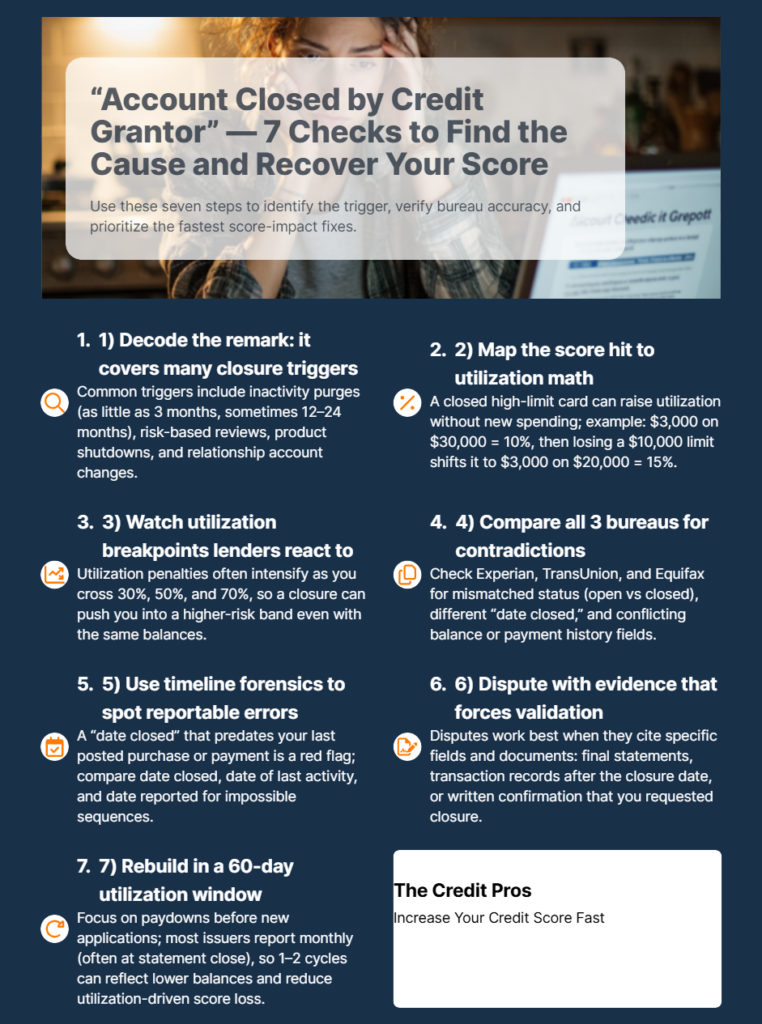
Losing a zero-balance card with a high credit limit often inflicts more score damage than carrying a balance on a low-limit card, a counterintuitive outcome that stems from how utilization thresholds trigger score band changes. If you had $30,000 in total available revolving credit with $3,000 in balances, you sat at 10% overall utilization—well within the optimal range. When your creditor closes the account with the $10,000 limit, your available credit drops to $20,000, and your utilization jumps to 15% even though you didn’t charge a single additional dollar. That five-percentage-point shift might seem minor, but if you were already carrying balances near certain thresholds, the closure could push you past critical breakpoints. Scoring models apply increasingly severe penalties as you cross 30%, 50%, and 70% utilization marks, with each threshold triggering a new band of score reduction. The card you lost might have represented your emergency buffer that kept your overall utilization in the safe zone, and its disappearance exposed utilization levels that were technically always there but previously diluted by that higher total credit availability.
Reconstructing your utilization snapshot from the day before closure versus the day after requires understanding statement closing dates and credit bureau reporting cycles. Your credit card issuers typically report your balance to the bureaus once per month, usually on your statement closing date, not your payment due date. If your account closed on January 10 but your statement closed on January 5, the bureaus might still be showing your pre-closure total available credit for several weeks until all your other cards report their next statement cycles. This creates a temporary window where your credit report hasn’t fully absorbed the utilization impact, and you might not see the score drop until mid-February when enough accounts have reported to reflect your new reality. Conversely, if the closure happened right before your statement closing dates across multiple cards, and you were carrying balances that you normally pay off after the statement cuts but before the due date, you might experience a double impact—the lost credit limit plus higher-than-usual reported balances on your remaining cards, all hitting the bureaus simultaneously.
The cascading effect on your remaining accounts creates a psychological and mathematical illusion where cards that were nowhere near their limits suddenly appear maxed out in relative terms. You might have a card with a $3,000 balance on a $5,000 limit, representing 60% utilization on that specific card. Before the closure, your overall utilization sat at a healthy 12% because you had $50,000 in total available credit. After losing $15,000 in available credit from the closed account, your overall utilization jumps to 18%, but more importantly, that individual card at 60% utilization now represents a larger portion of your total revolving credit picture. Scoring algorithms penalize high per-card utilization even when overall utilization remains reasonable, operating on the logic that maxing out individual cards signals financial stress regardless of your total capacity. The closure didn’t change your behavior or your actual debt load, but it mathematically transformed cards that were previously balanced into cards that now trigger high-utilization penalties.
The relationship between credit age and utilization creates a nuanced trade-off that determines whether a closure represents a temporary setback or a long-term problem. Closed accounts continue to age on your credit report and contribute to your average age of accounts for up to ten years after closure, meaning a closed account with 15 years of history still provides substantial age-of-credit protection even as it stops contributing to your available credit. If the closed account was relatively new—opened within the past two years—you’re losing credit availability without the compensating benefit of maintained credit history depth, creating a pure utilization crisis with minimal age-of-credit cushion. Conversely, if the closed account was your oldest card with a decade of history, you face a different calculation: the immediate utilization damage is identical, but you have ten years before that account falls off your report and you lose the age benefit, giving you a longer runway to rebuild other aspects of your credit profile before the closure creates secondary damage to your credit age metrics.
Checking All Three Credit Bureaus for Reporting Discrepancies
Creditors furnish account information to Experian, TransUnion, and Equifax through separate data feeds, and these parallel reporting streams frequently contain inconsistencies that reveal inaccurate or unreliable information. Your closed account might appear differently across all three bureaus, and these variations represent potential reporting errors that undermine the credibility of the closure itself and provide specific dispute leverage.
Status code variations across the three bureaus signal that the creditor’s reporting systems lack consistent data about your account’s actual state. You might pull your Experian report and see “account closed by credit grantor,” check TransUnion and find the same account listed as “account closed” with no specification of who initiated the closure, then discover on your Equifax report that the account still shows as “open” with available credit. These contradictory statuses prove the creditor cannot definitively establish what actually happened to your account or when. The legal framework governing credit reporting requires furnishers to report accurate information, and when the same creditor reports three different versions of the same account status, they’ve demonstrated their data is unreliable. This inconsistency matters beyond the immediate dispute because lenders performing manual underwriting reviews often pull reports from all three bureaus, and conflicting information raises red flags about data integrity that can work in your favor during reconsideration processes.
Date field forensics across the three bureaus expose timing errors that prove accounts were closed prematurely or reported before the actual closure occurred. The “date closed” field should match across all three reports if the creditor maintains accurate records, but discrepancies of weeks or months between bureaus indicate the creditor backdated the closure or reported it inconsistently. More revealing is the comparison between “date closed,” “date of last activity,” and “date reported” fields. If your date of last activity shows December 15, 2025, but the date closed shows December 1, 2025, the creditor is claiming they closed an account you were actively using. If the date reported shows November 28, 2025, but the date closed shows December 1, 2025, the creditor reported a closure before it happened. These temporal impossibilities provide concrete evidence that the reporting contains errors, and they’re particularly valuable when you’re disputing whether the closure was legitimate or whether you received proper notification.
Balance and payment history contradictions between bureaus reveal fundamental confusion in the creditor’s data systems. One bureau might show your account had a $500 balance at the time of closure while the other two show $0, indicating the creditor doesn’t have consistent records of your final account status. Payment history discrepancies create even stronger dispute grounds—if Experian shows your payment history as current through the closure date, but TransUnion shows a 30-day late payment in the month before closure, the creditor is reporting contradictory information about the same payment period. These inconsistencies matter because they suggest the closure itself might be based on inaccurate account information. If a creditor closed your account due to an alleged missed payment that only appears on one bureau’s report, you have evidence that the payment status triggering the closure was incorrectly recorded.
The misclassification between “closed by consumer” and “closed by credit grantor” represents one of the most common and impactful reporting errors. You might have called the creditor and requested account closure, received confirmation of your closure request, yet the account appears on your credit report as creditor-initiated. While both closure types have the same direct impact on your credit score—the account stops contributing to available credit either way—the distinction matters significantly for manual underwriting and future credit applications. Lenders reviewing your file manually often view consumer-initiated closures neutrally or even positively, interpreting them as responsible credit management or account consolidation. Creditor-initiated closures raise questions about why the issuer wanted to end the relationship, triggering additional scrutiny or reconsideration denials based on perceived hidden risk factors. Finding this misclassification requires comparing your records—emails, letters, or notes from phone calls where you initiated closure—against what all three bureaus show, because sometimes the error appears on only one or two reports while the third shows the correct closure type.
Building an Evidence-Based Dispute for Inaccurate Closures
Generic dispute letters generate generic investigations that rarely result in meaningful corrections, because credit bureaus and creditors process millions of disputes monthly through automated systems designed to validate existing data rather than uncover errors. Your dispute needs to force actual human review by presenting specific factual discrepancies that automated verification systems cannot reconcile, backed by documentation that contradicts what the creditor reported.
The strategic decision between disputing with the credit bureau first versus contacting the creditor directly depends on what type of error you’ve identified. When you’ve found discrepancies across the three bureau reports—different closure dates, conflicting status codes, or contradictory balance information—disputing with the bureaus first makes tactical sense because you’re highlighting inconsistencies in what the creditor furnished to different entities. The bureaus must contact the creditor to investigate, and when the creditor receives three separate investigation requests pointing out that they reported three different versions of the same account, they face pressure to correct all versions or remove the information entirely if they cannot verify accuracy. Conversely, when the closure reason is provably wrong but reported consistently across all three bureaus—such as an inactivity closure on an account you were actively using, or a creditor-initiated closure you actually requested—contacting the creditor directly first creates a paper trail of your attempt to resolve the issue before escalating to bureau disputes. This direct approach sometimes yields faster corrections because creditors can update their furnishing files immediately rather than waiting for bureau investigation cycles.
The specificity advantage in dispute language transforms vague challenges into investigations that require substantive responses. Disputing “account status is inaccurate” tells the bureau nothing about what you’re actually challenging, allowing them to send a generic verification request to the creditor, who responds “verified” without examining any details. Instead, disputing “account shows closed 11/15/2025 but my final statement dated 11/20/2025 shows account open with available credit of $10,000” forces the investigator to look at specific dates and reconcile a timeline that doesn’t work. Disputing “account reported as closed by credit grantor but I have email confirmation dated 10/30/2025 where I requested closure and received confirmation number C-8847392” requires the creditor to locate that specific interaction in their records and explain why they reported the closure differently. The more specific your dispute, the more difficult it becomes for the creditor to simply click “verified” without actually investigating, because you’ve identified concrete data points that contradict their reporting.
Your evidence package should contain documents that directly contradict specific elements of the reported closure, not general character evidence about your creditworthiness. Final statements showing available credit after the alleged closure date prove the account remained open beyond when the creditor claims they closed it. Correspondence where you requested closure—emails, secure message screenshots, or letters with certified mail receipts—proves you initiated the closure, not the creditor. Transaction records showing purchases or payments that posted after the reported closure date create timeline contradictions the creditor must explain. Credit monitoring alerts from third-party services showing the account as open on dates after the reported closure provide independent verification that contradicts the creditor’s timeline. What doesn’t carry weight in disputes: letters from you explaining why the closure was unfair, documentation of your good payment history on other accounts, or arguments about how the closure impacted your credit score. Bureaus and creditors only investigate factual accuracy of reported data, not the fairness or consequences of accurate reporting.
The reinsertion trap catches many people who successfully dispute an error, only to see the same incorrect information reappear on their credit report months later. This happens because creditors maintain master databases that feed information to the bureaus continuously, and unless the creditor corrects the error in their source system, they’ll eventually re-report the old data during system updates or migrations. When you dispute and achieve a correction or deletion, you should explicitly request in writing that the bureau flag your file to prevent reinsertion of the disputed information without notifying you first. Under the Fair Credit Reporting Act, if a bureau reinserts previously deleted information, they must notify you within five business days and provide the name, address, and phone number of the furnisher who provided the information. Maintaining a permanent dispute reference file with copies of all correspondence, confirmation numbers, investigation results, and corrected credit reports protects you when reinsertion occurs, because you can immediately reference the prior dispute and correction rather than starting from scratch.
Rebuilding Credit After Account Closure Without Triggering Risk Flags
Rebuilding after an account closure requires a sequenced approach that prioritizes utilization recovery before pursuing new credit, because applying for new accounts while your utilization sits at damaging levels compounds the problem rather than solving it. Your credit score takes an immediate hit from the closure-induced utilization spike, and if you respond by immediately applying for new credit cards, you’re adding hard inquiry damage and new account penalties to an already weakened score, likely resulting in denials that further damage your profile through additional inquiries.
The 60-day utilization recovery window represents your most critical rebuild period, during which your sole focus should be reducing balances on remaining cards to restore healthy utilization ratios before considering new credit applications. This timeline aligns with typical statement reporting cycles—most creditors report to the bureaus once monthly, so you need approximately two statement cycles to both reduce your balances and have those reduced balances reflected across all your credit reports. The pay-down timing strategy requires understanding when each of your cards reports to the bureaus so you can maximize the impact of your payments, targeting cards that report soon after you make payments to accelerate how quickly your improved utilization appears on your credit reports.
The Path Forward: Turning Account Closure Into Strategic Recovery
That “account closed by credit grantor” remark represents a crossroads, not a dead end. Whether your closure stemmed from inactivity, risk-based reviews, or creditor portfolio management, your recovery path depends on understanding the specific trigger behind the closure, verifying accuracy across all three bureaus, and sequencing your rebuild strategy to address utilization damage before pursuing new credit. The closures that feel most unfair—those triggered by factors completely unrelated to your payment behavior with that specific creditor—often provide the strongest dispute grounds when you identify reporting inconsistencies or timeline contradictions. Even legitimate closures become manageable when you focus on what you can control: reducing balances strategically, timing payments to align with reporting cycles, and rebuilding available credit only after your utilization ratios recover.
The real question isn’t whether you can recover from an involuntary account closure—you can—but whether you’ll treat the generic remark on your credit report as the final word, or as incomplete information that demands verification, context, and a calculated response based on your actual situation rather than assumptions about what that closure means.
-
Previous Post
Income-Driven Underwriting: 7 Insights For Success
-
Next Post
5 Steps To Boost Credit
Related Posts

5 Steps To Boost Credit
You added a 100-word explanation to your credit report thinking it would help lenders understand…

Income-Driven Underwriting: 7 Insights For Success
You’ve checked your credit score—it’s sitting comfortably above 700. You’ve paid every bill on time,…

Statute of Limitations vs Credit Reporting Time Limit: Why ‘Time-Barred’ Debt Can Still Appear on Your Report
You probably think once a debt becomes too old to sue over, it disappears from…

Bad Credit To Better Credit: A Realistic 60–90 Day Recovery Plan (Even With Collections)
You’ve been turned down for that apartment. The car loan came back with a 24%…

